

State of the Prairie II: Understanding Ecosystem Health and the Role of Fire in Building Resilient Landscapes
Emerging Research and Innovations in Prairie Conservation
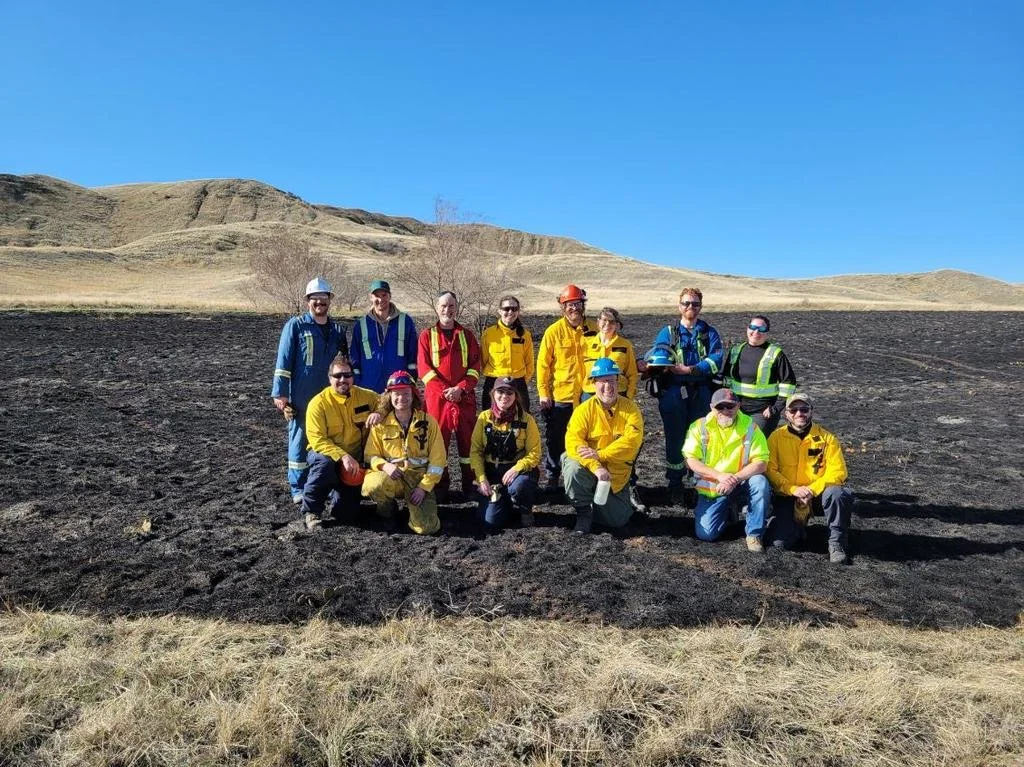
Photo of the prescribed fire conducted at Sask Landing, adjacent to Matador, by members of the Canadian Prairies Prescribed Fire Exchange in spring 2025
Photo Credit: Darcy Griffin
The future of prairie conservation will depend upon our ability to better understand, measure, and manage these complex ecosystems using a combination of science, technology, traditional knowledge, and collaborative stewardship. Emerging research and innovation are providing unprecedented opportunities to improve the effectiveness of grassland conservation and restoration efforts across the Canadian Prairies. These advances are helping managers evaluate ecosystem condition, identify threats, prioritize interventions, and monitor outcomes at scales ranging from individual sites to entire landscapes.
Research is increasingly focused on adaptive ecosystem management, recognizing that prairie systems are inherently dynamic and that uncertainty is an unavoidable component of conservation planning. Adaptive management treats management actions as learning opportunities, where ecological outcomes are measured, evaluated, and incorporated into future decision-making. This approach improves the effectiveness of conservation investments while allowing managers to respond more effectively to changing environmental conditions, emerging threats, and new scientific understanding.
The development of integrated ecological databases and decision-support tools represents another important innovation. Centralized information systems that combine field monitoring data, remote sensing products, habitat inventories, and management records allow practitioners to better track ecosystem condition, identify trends, evaluate treatment effectiveness, and coordinate conservation actions across jurisdictions. These systems strengthen collaboration, reduce duplication of effort, and provide a foundation for evidence-based management.
Growing research into the ecological interactions between fire, grazing, soils, and biodiversity is improving our understanding of how disturbance processes maintain prairie resilience. Studies examining integrated fire-grazing strategies are demonstrating how prescribed fire can be used to restore ecological heterogeneity, improve wildlife habitat, enhance native plant diversity, and increase the effectiveness of invasive species management. These approaches more closely emulate the historic disturbance regimes that shaped prairie ecosystems for thousands of years.
Climate adaptation has emerged as a major area of conservation research. Scientists and land managers are increasingly evaluating how changing temperature and precipitation patterns may affect native species distribution, ecosystem productivity, carbon storage, and habitat suitability. Future conservation efforts will likely focus on identifying climate-resilient plant communities, protecting landscape connectivity, enhancing ecosystem function, and developing management strategies capable of sustaining prairie biodiversity under changing environmental conditions.
There is renewed interest in integrating Indigenous knowledge and cultural fire stewardship into contemporary grassland management. Indigenous peoples have used fire for millennia to influence vegetation patterns, support wildlife, and maintain healthy landscapes. Collaborative approaches that combine traditional ecological knowledge with western science offer significant opportunities to improve prairie management while strengthening relationships among Indigenous communities, governments, researchers, and conservation organizations.
Perhaps the greatest opportunity lies in expanding collaborative conservation networks across the Prairie Provinces. Partnerships among landowners, Indigenous communities, government agencies, universities, conservation organizations, and prescribed burn associations are improving information sharing, building management capacity, and increasing the scale at which conservation can occur. Initiatives focused on practitioner training, prescribed fire implementation, ecological monitoring, and landscape-scale restoration will be critical to restoring ecological processes and building resilient prairie ecosystems for future generations.
Together, these innovations are moving prairie conservation toward a more adaptive, collaborative, and science-based future—one that embraces natural processes, leverages emerging technologies, and recognizes that healthy grasslands are essential for sustaining biodiversity, ecological goods and services, and the cultural and economic values that prairies provide to society.
Dale Gross,
Government of Saskatchewan
Park Grassland Ecologist
Landscape Protection Unit, Ministry of Parks, Culture & Sport