
How Prescribed Fire Helps Protect Communities: Understanding Wildland-Urban Interface Fires on the Prairies
"The best time to reduce wildfire risk is long before smoke appears on the horizon."
Every summer, Canadians watch communities across the country confront increasingly destructive wildfires. Public attention tends to focus on forests, but prairie communities face a real and growing version of the same threat. Native grasslands, shrubs, and unmanaged vegetation can carry fire quickly, especially in hot, dry, windy conditions typical of a Saskatchewan summer.
One of the most effective tools for reducing that risk is prescribed fire: a carefully planned, deliberately set fire used to remove hazardous fuel before wildfire season puts it to the test. Far from being the opposite of wildfire, prescribed fire is one of the primary ways specialists prevent catastrophic wildfires before they start.
What Is the Wildland-Urban Interface?
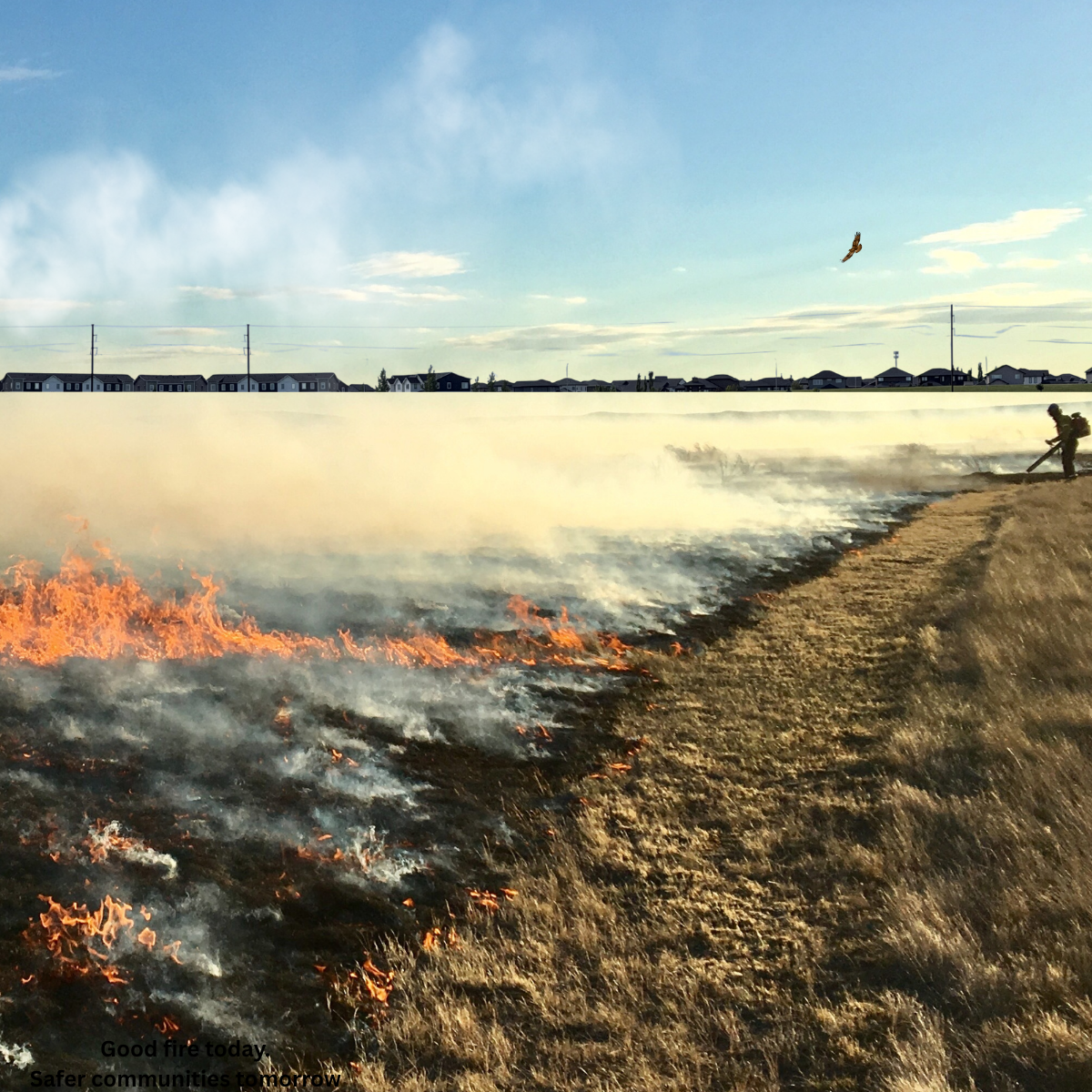
The Wildland-Urban Interface (WUI) is the zone where homes, neighbourhoods, farms, businesses, and infrastructure meet or are interspersed with natural vegetation, grasslands, forests, and shrublands. It is one of the most consequential concepts in modern wildfire management, because it is where a natural, often beneficial, ecological process becomes a direct threat to people and property.
The scale of the issue in Canada is larger than most residents realize. Nationally, roughly 32% of Canadian communities sit in or near the WUI [1], and mapping studies put the total WUI footprint at more than 32 million hectares, about 3.8% of Canada's land area [2]. The National Research Council of Canada has flagged WUI fire risk as a growing national concern, driven by expanding development, rural population growth, and a changing climate that is making wildfires more frequent and severe [3]. Research specifically identifies the boundary between the prairies and the boreal forest as one of the highest-risk zones in the country, where dense development overlaps with high fuel loads [2].
Across Saskatchewan, this plays out at a local scale: conservation areas, parks, and natural grasslands sit directly alongside growing neighbourhoods. Protecting these landscapes is inseparable from protecting the people, homes, roads, and utilities next to them.
Why Grasslands Matter
Prairie grasslands are not empty space between farms and towns; they are one of the most biodiverse and most endangered ecosystems on Earth. The International Union for the Conservation of Nature has identified temperate grasslands as the least protected and most at-risk biome on the planet [4]. In Saskatchewan specifically, independent assessments estimate that only 17–21% of the original native mixed-grass prairie remains intact, and less than 1% of what's left carries any formal protection [4] [5].
That remaining prairie supports:
- Hundreds of native plant species, as many as 50 to 100 species of grasses and wildflowers in a single quarter-section of land [5]
- Pollinators, including native bees and butterflies
- Grassland birds whose populations across the Great Plains have fallen by an estimated 65–94% since surveys began in the 1960s [5]
- Mammals, reptiles, and countless invertebrates
- Deep-rooted soils that store carbon and regulate water infiltration
These landscapes evolved with fire. For thousands of years, lightning strikes and Indigenous cultural burning created recurring fire cycles that kept fuel loads in check [6]. Since European settlement suppressed that fire regime, dead grass, woody encroachment, and invasive species have been allowed to accumulate, creating exactly the dense, continuous fuel that feeds fast-moving, high-intensity wildfires [6].
What Is Prescribed Fire?
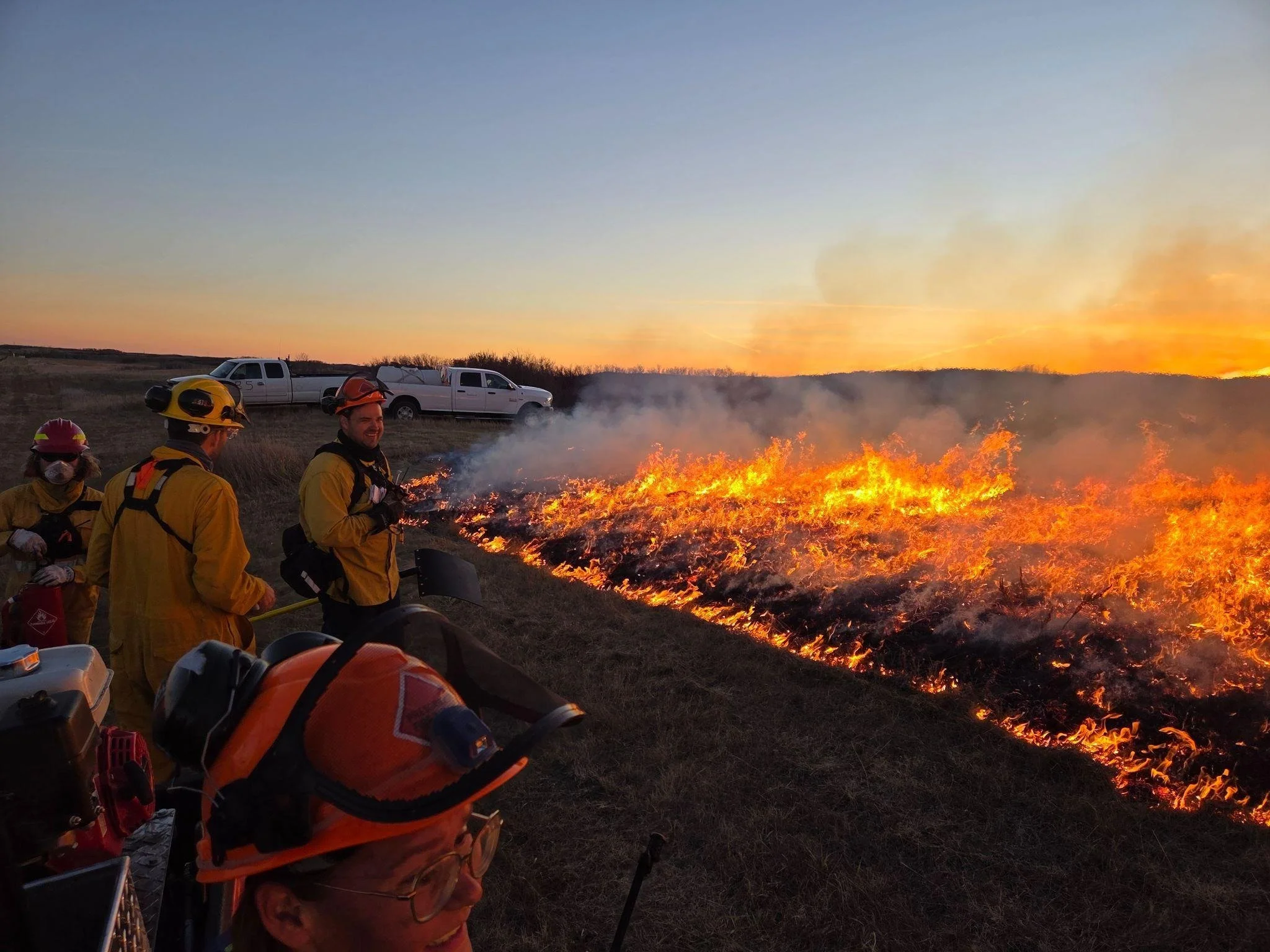
A prescribed fire is a planned, intentionally ignited fire, conducted by trained practitioners under a strict set of predetermined conditions. Every burn follows a detailed burn plan built around:
- Weather forecasts, wind speed, and direction
- Relative humidity and fuel moisture
- Modelled fire behaviour
- Smoke management
- Wildlife and ecological considerations
- Contingency and emergency response plans
- Personnel, equipment, and communications protocols
If any of these conditions fall outside the plan's parameters, the burn does not proceed.
Safety is the non-negotiable priority at every stage.
How Prescribed Fire Reduces Wildfire Risk
Prescribed fire works on a simple principle: a fire cannot be intense if there isn't enough fuel to sustain it. After a prescribed burn:
- Excess dead grass and accumulated litter are removed
- Remaining fuel becomes lighter and patchier across the landscape
- Any future fire that does occur tends to burn with lower intensity and spread more slowly
- Firefighters gain safer, more effective opportunities to contain wildfires that do start
In effect, prescribed fire reduces the amount of fuel available before an accidental ignition ever has the chance to use it.
Building More Resilient Landscapes
Fire-adapted prairie ecosystems tend to be healthier ecosystems. Regular, well-managed prescribed fire helps:
- Suppress invasive species and woody encroachment that raise fire hazard
- Stimulate vigorous native grass regrowth
- Improve habitat for grassland-dependent wildlife
- Increase plant diversity
- Recycle nutrients into the soil
- Break up fuel continuity across the landscape
Ecosystems maintained in this way are generally better able to withstand drought, pest pressure, and wildfire than landscapes left unmanaged.
Protecting Communities Through Collaboration
No single organization can carry wildfire preparedness alone. In Saskatchewan, this work happens through the Canadian Prairies Prescribed Fire Exchange (CPPFE) an inter-agency collective, housed within the Meewasin Valley Authority, that builds capacity for prescribed fire through training, equipment-sharing, and a shared grassland fire science database [7]. The CPPFE doesn't conduct burns itself; instead, it connects the people who do: land managers, ranchers, conservation groups, municipal and federal agencies, Indigenous Knowledge holders, researchers, volunteer fire departments, and academic partners [7] and points community partners in the right direction for trainings.
That network trains up quickly. The CPPFE's Prescribed Fire Training Exchange (TREX) has grown each year since its first event in October 2022, drawing more than 60 participants from 27 partner agencies across Canada and the U.S. to its fourth Saskatoon-area event in October 2025; the largest in the program's history [8].
Prescribed Fire Is Only One Piece of the Solution
No single tool eliminates wildfire risk. Communities strengthen their own resilience by:
- Creating defensible space around homes
- Removing flammable vegetation close to structures
- Keeping roofs and gutters clear of debris
- Choosing fire-resistant landscaping where practical
- Preparing household evacuation plans
- Supporting community-level wildfire preparedness initiatives
Living FireSmart™
FireSmart™ is Canada's national program for reducing wildfire risk at the property and neighbourhood level [9]. In prairie communities, the most relevant FireSmart principles include:
- Keeping grass mowed near structures
- Reducing combustible material around homes
- Managing shrubs and trees near buildings
- Maintaining clear access routes for emergency responders
- Preparing properties ahead of wildfire season
Landscape-scale fuel management prescribed fire, in this case complements what individual homeowners do on their own properties. Residents reduce risk immediately around their homes; prescribed fire reduces risk across the much larger natural areas that surround them. Communities that combine both approaches enter each wildfire season better prepared than those relying on either one alone.
Good Fire Protects What We Value
Fire has shaped prairie ecosystems for thousands of years. Used responsibly, prescribed fire restores ecological balance while actively reducing the conditions that let destructive wildfires spread. It protects biodiversity in one of the world's most endangered ecosystems. It supports healthy native grassland. It reduces hazardous fuel loads before they become someone's emergency.
Most importantly, it helps safeguard the people, places, and communities that call the Prairies home.
Good fire isn't about creating risk. It's about reducing it, carefully, responsibly, and together.
References
1. Flash Wildfire Services, The Wildland-Urban Interface: Challenges and Opportunities (2024). flashwildfireservices.ca
2. Johnston & Flannigan, Mapping Canadian wildland fire interface areas, International Journal of Wildland Fire (2018). doi.org/10.1071/WF16221
3. National Research Council of Canada, New National Guide for Wildland-Urban Interface Fires (2021). nrc.canada.ca
4. CBC Nature of Things, Canada's beautiful prairie grasslands are among the most endangered ecosystems in the world; Saskatchewan Prairie Conservation Action Plan, What Is Native Prairie. pcap-sk.org
5. Ducks Unlimited Canada, Grasslands; Prairie Commons, The state of native prairie in Saskatchewan. ducks.ca; prairiecommons.ca
6. Canadian Prairies Prescribed Fire Exchange, Home. grasslandfire.ca
7. Canadian Prairies Prescribed Fire Exchange, About Us. grasslandfire.ca/about
8. Meewasin Valley Authority, News Release: Canadian Prairies Prescribed Fire Exchange Training Event (October 2025). meewasin.com
9. FireSmart Canada, The Wildland Urban Interface (WUI). firesmartcanada.ca