
Two Terms, One Prairie Fire: What’s the Difference Between Pyric Herbivory and Patch-Burn Grazing?
If you spend any time reading rangeland science, attending extension workshops, or listening to pasture managers talk about prescribed fire, you’ve likely encountered two terms that are sometimes used as though they mean the same thing: pyric herbivory and patch-burn grazing.
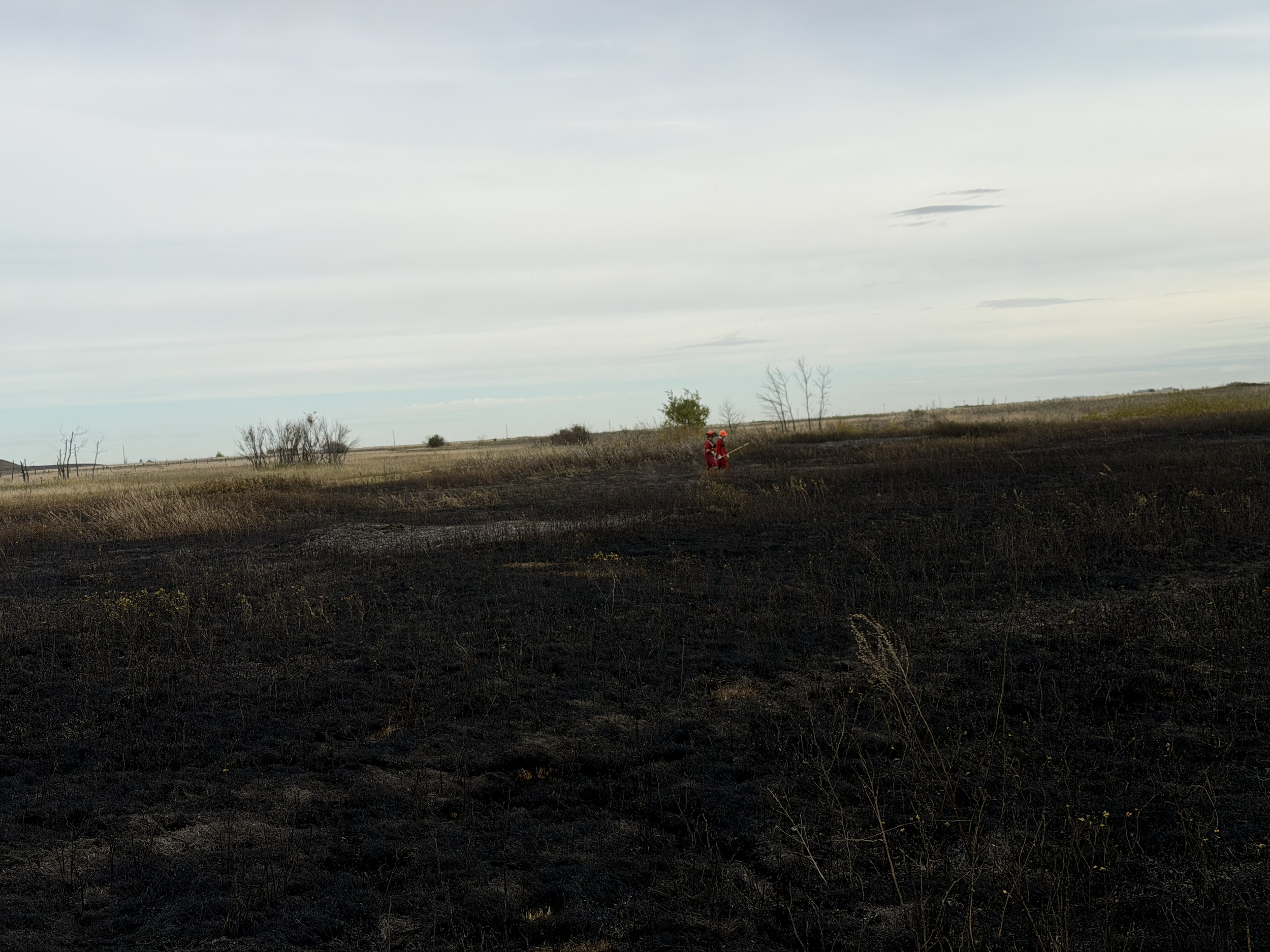
To the casual observer, they certainly look similar. In both cases, fire removes standing dead vegetation and litter from part of a grassland, new vegetation emerges following the burn, and livestock or wild grazers often concentrate their grazing on the recently burned area.
So, is this just academic jargon splitting hairs? Or is there a meaningful distinction that matters for how we talk about, design and manage working landscapes?
There is a useful distinction.
Put simply, pyric herbivory describes an ecological process, while patch-burn grazing is a management approach that deliberately harnesses that process.
Pyric Herbivory: The Ecological Process
Think of pyric herbivory as the ecological interaction between fire and grazing.
The term describes feedback between the two disturbances across space and time. Fire changes vegetation and influences where herbivores choose to graze. Concentrated grazing then changes vegetation structure and fuel loads, which can influence the location, behavior and effects of subsequent fires. Researchers describe this interaction as producing a “shifting mosaic” across the landscape, with patches differing in vegetation structure, grazing intensity and time since disturbance.
Long before modern grazing plans, cross-fencing and prescribed-burn programs, fire and large-herbivore grazing interacted across grasslands such as the Great Plains. Fires originated from both natural ignition, including lightning, and deliberate Indigenous burning. Indigenous peoples influenced historical Great Plains fire regimes, including through burning associated with bison hunting and land management.
Large grazers such as bison preferentially use recently burned areas, where post-fire vegetation can offer attractive forage. As grazing becomes concentrated in those areas, other parts of the landscape may receive lighter grazing and accumulate more vegetation and litter.
Over time, this creates differences among patches. A heavily grazed area may have relatively little standing biomass, while a less-grazed area may grow taller and accumulate more litter and fuel. When fire occurs elsewhere, grazing pressure can shift again, allowing previously grazed areas to recover.
The result is heterogeneity, or variation in vegetation height, composition, biomass and disturbance history across the landscape. That variation can provide habitat for wildlife species with very different vegetation requirements.
Patch-Burn Grazing: The Management Application
Patch-burn grazing takes that ecological interaction and uses it deliberately as a management strategy.
A land manager applies prescribed fire to a portion, or “patch,” of a larger grazing unit. Livestock remain free to move across the area but tend to concentrate grazing on the most recently burned patch because post-fire regrowth is often attractive and palatable. When another patch is burned later, grazing pressure can shift with it.
Rather than relying entirely on fences to determine where animals graze, managers can therefore use fire to help influence livestock distribution.
Reduced Reliance on Internal Fencing
One attraction of patch-burn grazing is its potential to reduce reliance on cross-fencing as the primary means of controlling grazing distribution. Livestock can choose among burned and unburned areas, with greater grazing pressure generally occurring on recently burned vegetation and lighter use elsewhere.
That does not mean internal fencing is never useful or necessary. Water location, pasture size and shape, livestock class, stocking rate and management objectives still matter. Fire is another tool for influencing animal distribution, not a universal replacement for good grazing management.
Burns Shift Through Time
Patch-burn grazing usually involves applying fire to different parts of a pasture over time.
Some systems, for example, burn roughly one-third of a pasture each year, creating a three-year sequence. But a three-year rotation is not a requirement. Patch size and the timing and frequency of prescribed burns should reflect local conditions and management objectives.
The defining feature is not a particular rotation length. It is the movement of fire and grazing pressure across the landscape through time.
Creating Variation Instead of Uniformity
Patch-burn grazing also differs from management approaches aimed primarily at achieving uniform livestock use.
Instead of trying to make every acre look the same, managers intentionally allow differences to develop. A recently burned and heavily grazed patch may have short vegetation, another may have intermediate vegetation, while an area that has gone longer without fire or concentrated grazing may have taller vegetation and greater litter accumulation.
This creates a heterogeneous landscape that can provide different resources for livestock and wildlife.
Prescribed fire may also help address woody plant encroachment where fire is ecologically appropriate, although responses vary among plant species, ecosystems and fire regimes.
The Comparison at a Glance
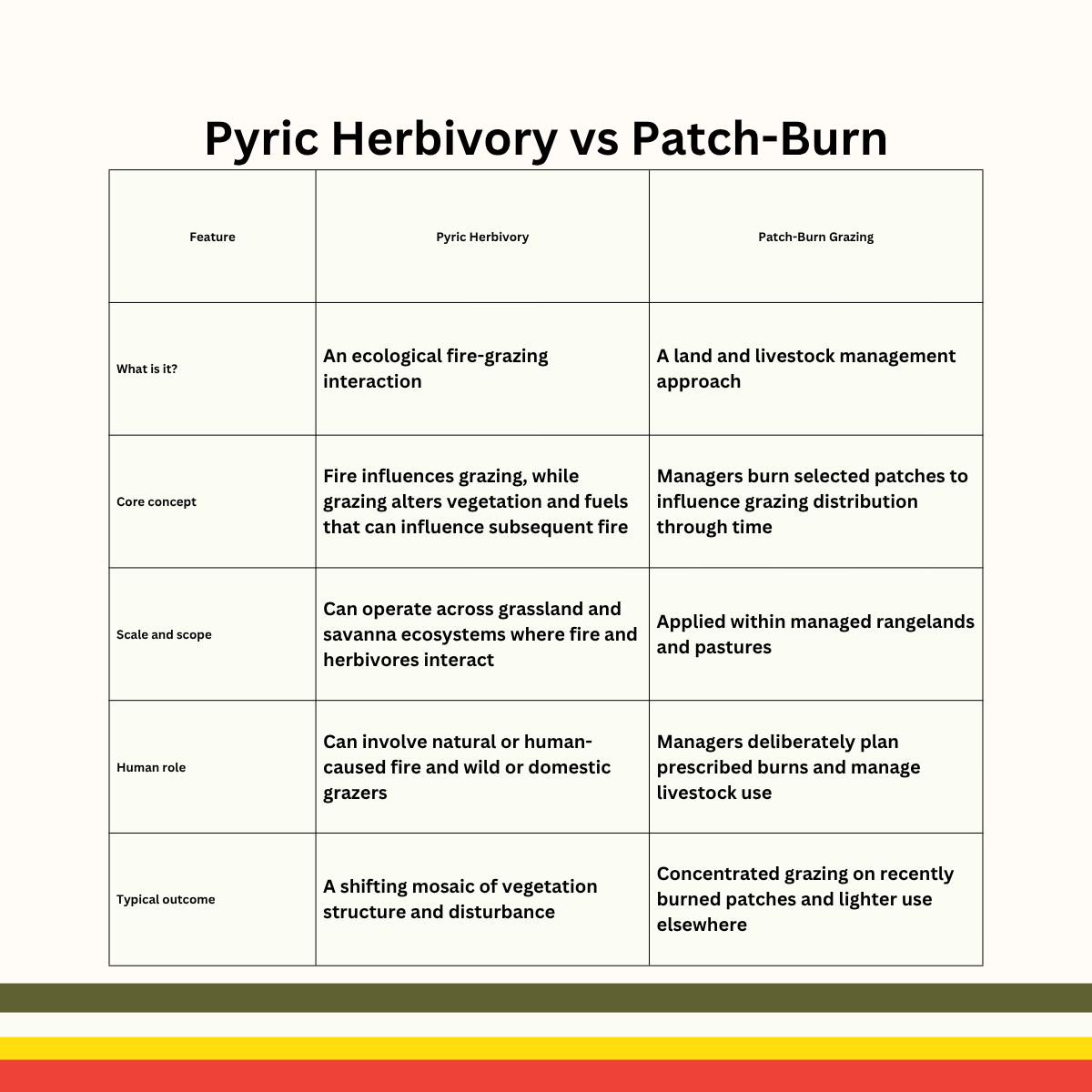
One distinction is particularly important: pyric herbivory does not necessarily mean “natural” or “without humans.” Prescribed fire and domestic livestock can also create a fire-grazing interaction.
Research in Saskatchewan, for example, has examined prescribed fire, bison and cattle movement through the lens of pyric herbivory and found increased cattle visitation to recently burned areas. Patch-burn grazing is therefore best understood as one deliberate management approach for harnessing pyric herbivory.
Why the Distinction Matters for Development and Extension
Why bother distinguishing between these terms? This is because they answer different questions.
Pyric herbivory helps explain why fire and grazing interact. It encourages us to see them not simply as isolated disturbances, but as ecological processes capable of influencing one another across space and time. It also helps reframe fire as more than a disaster or a tool used only to control unwanted vegetation. In fire-adapted grasslands, fire can influence vegetation structure, grazing distribution, fuel patterns and habitat.
Patch-burn grazing asks how managers might put that knowledge into practice.
The practical questions become:
How much of a grazing unit should be burned?
When should burning occur?
How will cattle respond?
How will stocking rate affect the results?
What will happen to unburned vegetation?
How will the resulting vegetation structure affect wildlife habitat?
How does prescribed fire fit with other tools for managing woody vegetation, forage and fuel?
These answers will vary among landscapes and operations.
The distinction also helps prevent us from overselling patch-burn grazing. It is not a rigid recipe guaranteeing improvements in forage quality, livestock production, drought resilience, or brush control. Outcomes depend on climate, vegetation, stocking rates, fire timing, soils, animal behavior and management objectives. Instead, patch-burn grazing is better understood as a framework for strategically reconnecting fire and grazing.
One Prairie Fire, Two Useful Terms
The easiest way to remember the distinction is: Pyric herbivory is the ecological process. Patch-burn grazing is one management approach that intentionally harnesses that process. Understanding pyric herbivory helps explain what happens when fire and grazing interact. Patch-burn grazing asks how that knowledge can be deliberately applied on modern working landscapes. That distinction helps bridge ecological research and practical land stewardship. It also points to a broader lesson: effective grassland management does not always mean making every acre look or behave the same. In some systems, the variation created by fire, grazing, rest and recovery is precisely the point.