
The life of a CPPFE summer student
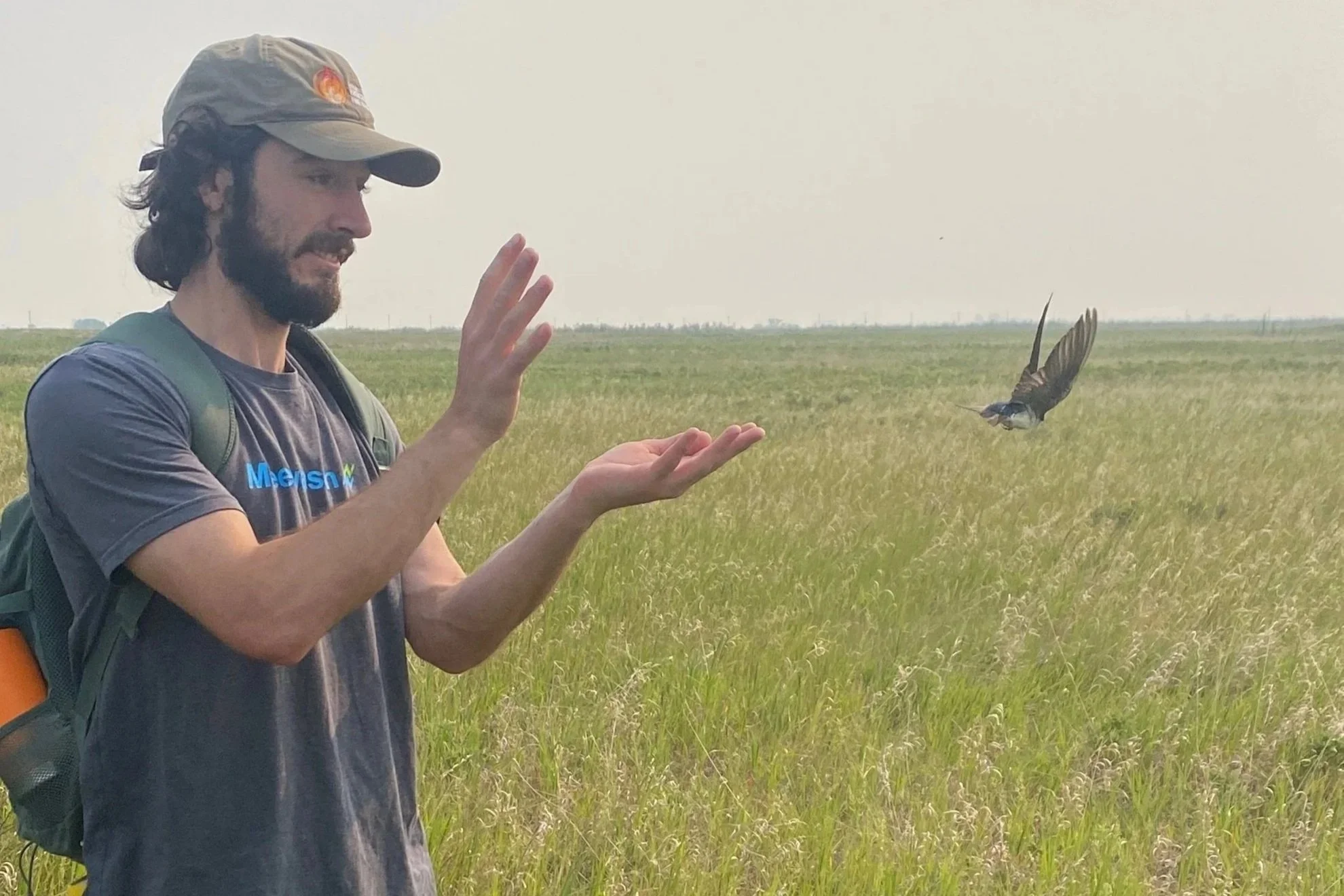
Jacob Murphy was a summer student for the CPPFE in 2025.
As a summer student in resource management for the Canadian Prairies Prescribed Fire Exchange (CPPFE), I had many opportunities to learn about what goes on before, during and after a prescribed burn.
The position focused mainly on the vegetative monitoring aspect of prescribed burns, but there was still a wide variety of field, lab and course work that Aisha, the other summer student at the CPPFE, and I completed.
The majority of these tasks were new to me, so it was quite the learning experience, but I mean that in the best of ways. We also had the pleasure of collaborating with departments within Meewasin and other organizations across the Prairies.
My background
I started working at Meewasin four years ago in 2021 as a conservation labourer. I was finishing a kinesiology degree at the time and was simply in need of a summer job.
So, at the suggestion of a relative I applied to Meewasin and got hired. However, as I kept returning, I saw and assisted with the work that was being done by the resource management and CPPFE summer students. This piqued my interest in an ecological focused career path.
I have always been infatuated with the outdoors as I had spent countless hours of my childhood exploring the natural world. I had the family farm, visits with my relatives in British Colombia and family camping trips. Eventually, I committed to starting an environmental biology degree and in the following year I was fortunate enough to be hired on with the CPPFE.
The first few weeks of work were a rush of new information, work procedures and responsibilities. While it was never overwhelming given the great workplace environment of Meewasin and CPPFE, it did keep me on my toes.
What are transects and quadrats?
I first learned the basics about transects and quadrats and how the CPPFE utilizes them, as they come in all shapes and sizes. A transect, in our case, is a 50m line between two stakes that usually runs north to south. Quadrats are samples taken from within a transect.
We would use five quadrats for each transect, so that we can average the results from each quadrat to account for outliers and/or missing data. My introduction to the use of transects was doing soil bulk density sampling across the Meewasin sites including Beaver Creek, The Northeast Swale and Cranberry Flats.
What is soil bulk-density?
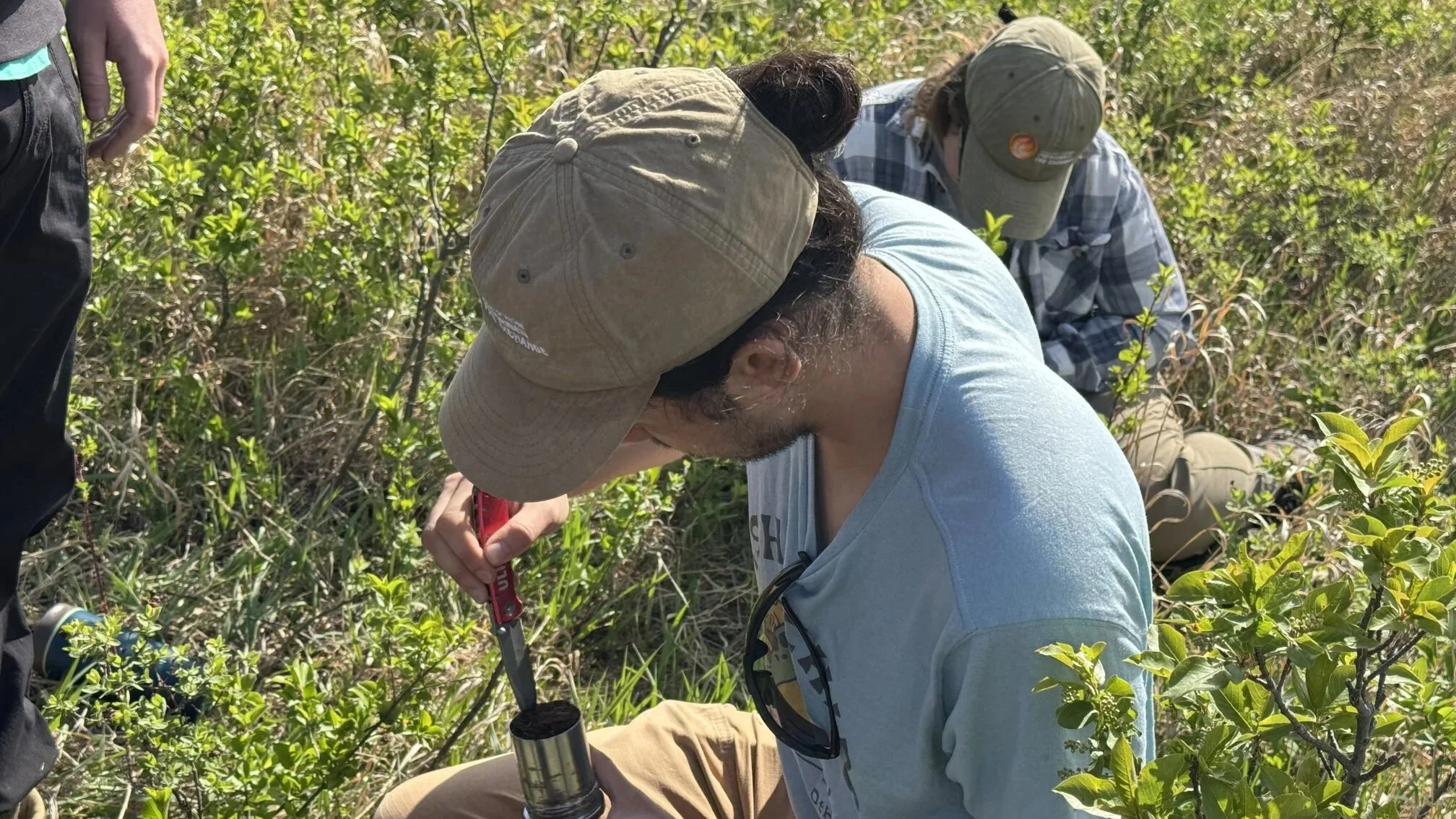
Photo: Jacob working out in the field in May 2025.
Soil bulk density, as the name suggests, is a measure of the amount of soil within a set amount of volume or space. This is achieved by taking samples of soil in a cylinder of a known volume, then using a formula to determine the soil density. For our work, we took samples at depths of 10, 20 and 30cm for each quadrat.
Why is soil bulk density important?
The roots of plants help maintain a healthy soil compactness, by penetrating through the soil during growth, while leaving behind space and nutrients once they die and breakdown. Conversely, if soil is too compacted, most plants will not grow well as there is less available space for plant roots, nutrients and water.
Vegetative monitoring
We also used transects for vegetative monitoring. This entails three different types of sampling all done in one go.
The first is percent coverage. This is an estimate of how much area, given as a percentage of the whole quadrat, a specific plant covers. We can use this information to gain insight on topics like how healthy an ecosystem is, if a prescribed burn achieved its objectives and if they are the right choice to achieve the intended outcome.
The next part of vegetative monitoring was clipping which, as the name suggests, involves cutting and gathering all of the plant matter in a half meter by half meter square (size of square can vary). The clippings are separated into grasses, forbs, shrubs and litter. The collected samples are then dried in an oven and weighed to find dry mass for each of the categories. This can be used to compare different locations or experiment conditions to one another, determine how successful the plants within the ecosystem are at capturing and converting energy to plant matter, and decide if there is a risk of a severe fire due to the buildup of litter. Litter is dead plant matter that is generally a more combustible fuel than living plant biomass and one common objective of prescribed burns in grasslands is to reduce the amount of litter so that any fires in the same area will be less intense due to the lack of available fuels.
The final part of vegetative monitoring is taking soil samples. Soil samples are not separated into depth levels and there is no uniform volume needed. Instead, one sample per quadrat is collected then burned in a furnace at 950ºC, which is not done for our bulk density samples. The difference in the weight of the soil pre and post burning represents the amount of organic matter in the soil, as that is what burns off. We want to know more about the organic matter in the soil, as it can give us an indication of ecosystem health, what kinds of plants may be more likely to thrive in the area (as some plants grow better in poor soil then those that thrive in rich soils) and carbon cycling in the soil.
My big takeaways
Identifying plants, while seemingly daunting at first, became the most interesting part of the vegetative monitoring process to me as I got to learn more about the composition of the mixed-grass prairies I call home.
This opened up a whole new world, as I learned what each plant can/has been used for, where they like to grow, and what their key features are. I even started to notice this when walking around. I could see the individual plants and grass, when before my brain mostly just lumped all of them together into a mass of green. I feel like I appreciate my surroundings and the uniqueness of each plant significantly more than before, and I am still just a beginner when it comes to plant identification.
Another aspect of working for the CPPFE I enjoyed was the collaboration work with the Meewasin resource management crew and other organizations. This included activities like bat and bird surveys, setting up ARU’s, bird banding and site monitoring in Alberta and southern Saskatchewan.
These were all great experiences that allowed me to learn from amazing down-to-earth people who take pride in what they do and are more than willing to teach others about what they know. I never felt uncomfortable asking for help identifying plants, or clarification on the current job.
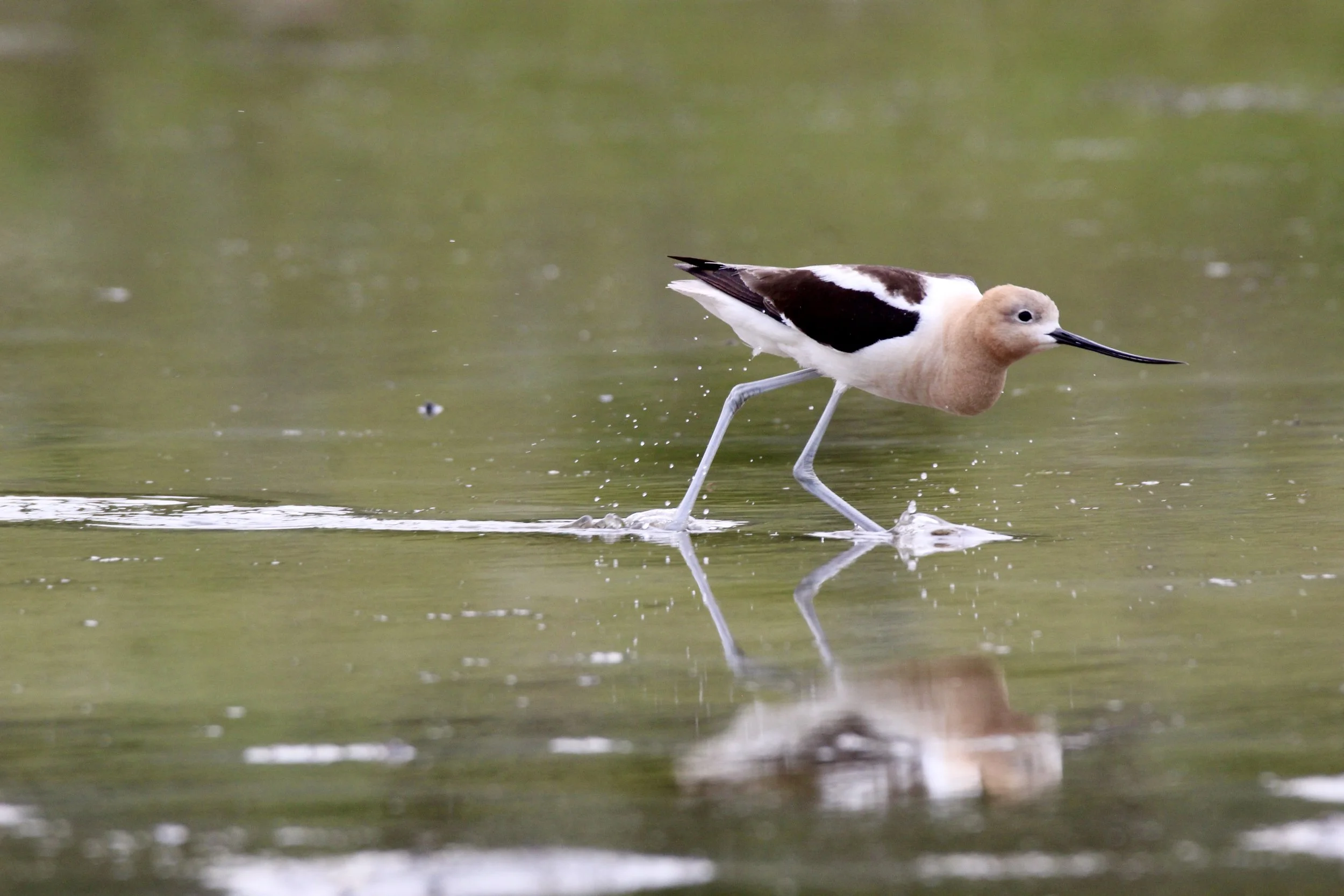
Being out in the field also enabled me to take my camera out during my lunch breaks to take photos of the wildlife. This leads to another positive of working for the CPPFE: the workplace is a perfect mix of hard work and easy-going attitudes. This left me feeling like work was getting done without any undue stress or pressure to meet unreasonable goals.
Photo: Jacob Murphy
My summer with the CPPFE was filled with many practical, hands-on jobs that did not even feel like work most of the time (because I enjoyed it, not because we were slacking).
It provides most the things you could ask for from a summer job: learning opportunities, chances to create lasting friendships with peers in similar fields, technical skills and introducing you to lab and field work. I would recommend this position to anyone that has an interest in ecology, biology, agriculture, or other natural sciences - even those with less field work experience much like myself before this summer.
I am forever grateful that I was able to have this work opportunity, and it will always be important step in my life that created many memories and experiences.